Author: Chris

  • Summer Shandy

    He was sitting on the porch near the shadow of the gazebo, rocking on the coiled-wire hinge of his deck chair. The August sun was waning as evening – and with it dinner – approached. He allowed himself to let his focus blur as he took a long pull that finished the bottle of Summer Shandy he’d been nursing for the past half-hour. The waves of Lake Michigan and the sandy shores had called it a truce for the day, and were in the process of retreating to their front lines. And then the baritone grate of the sliding door jostled him upright in his chair, and as he slowed the pulse of his rocker she said, “dinner’s ready.”

    Written from 6:40 am to 7:00 am on Thursday, February 9th, 2012 at home in Traverse City, Michigan.

  • Top 5 Regrets of the Dying

    From the UK Guardian, a nurse polled dying patients for their regrets. The top five results were:

    1. I wish I’d had the courage to live a life true to myself, not the life others expected of me.
    2. I wish I hadn’t worked so hard.
    3. I wish I’d had the courage to express my feelings.
    4. I wish I had stayed in touch with my friends.
    5. I wish that I had let myself be happier.

    This reminds me of a country song I used to listen to on the bus ride to North Campus at the University of Michigan for piano class. The song was, “I Hope You Dance,” by Lee Ann Womack. Its message is one of those cliches that encourages you to seize the day, live without regrets, etc. that is in horrible conflict with the fact that 99% of us have to work very hard for a living. Yet that song, along with dozens of quotes that I come upon each month while browsing the internet and the above informal poll, all work to remind us to be conscious of our mortality and that of those around us.

    I’ve found that No. 1 is difficult and always will be difficult because I care about those around me, and because of that love I am committed to living, at least in part, for them – as a husband, as a son, as a brother, as a friend. Inevitably, that pulls at my own selfish desires. That’s okay! No. 2 is a life-long challenge, but pursuing a profession that I find rewarding helps balance the reality of sitting inside on sunny days. I’m a man, so No. 3 doesn’t exist. Juuuuust kidding. I am better at expressing my feelings through writing than vebally, but that’s a start. No. 4 will always be difficult because it’s like trying to hit a moving target. Who’s married, single, in town, not too busy, I still have contact information for, etc. There’s a multitude of variables, and not enough time. Most important is to remember to keep putting myself out there, and ask friends out instead of waiting for an invitation.

  • Life Revisited – My Crepe Stand Plan

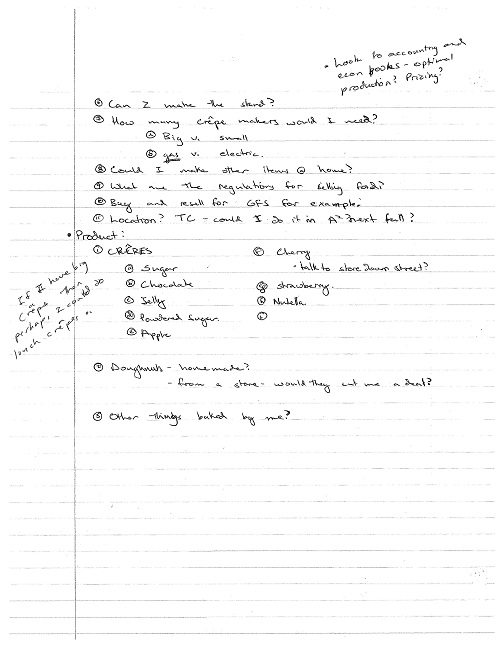
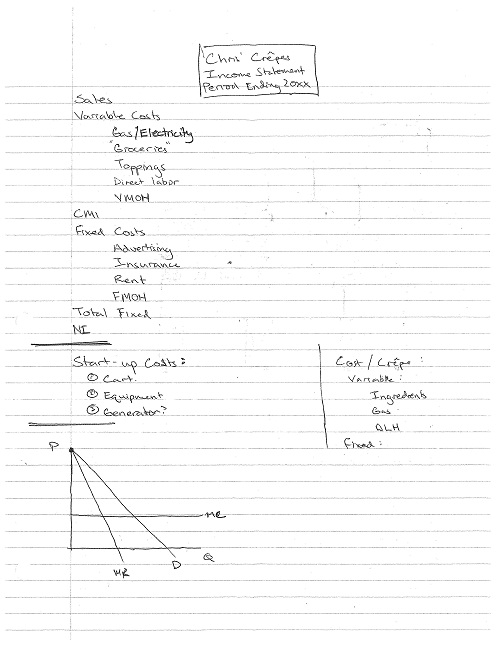
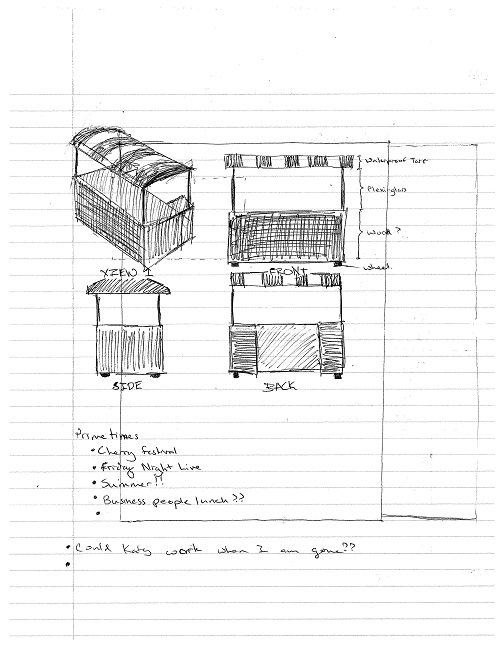
    Back in 2002 when I was a sophomore at the University of Michigan, and probably for some time before that, I had plans or dreams to open a crepe stand. While chatting with the bartender, Dan, at the TCG&CC last night the topic came up again as I ordered the chicken and mushroom crepes for dinner. My plans from 2002 are below. Fun to think about – maybe even a good business model during busy festivals.


  • Hawthorne’s Observation of Thoreau

    From Nathaniel Hawthorne’s journal, published as American Notebooks (1835-42):

    September 1, 1842. Mr. Thoreau dined with us yesterday…. He is a keen and delicate observer of nature–a genuine observer–which, I suspect, is almost as rare a character as even an original poet; and Nature, in return for his love, seems to adopt him as her especial child, and shows him secrets which few others are allowed to witness. He is familiar with beast, fish, fowl, and reptile, and has strange stories to tell of adventures, and friendly passages with these lower brethren of mortality. Herb and flower, likewise, wherever they grow, whether in garden or wildwood, are his familiar friends. He is also on intimate terms with the clouds, and can tell the portents of storms. It is a characteristic trait that he has a great regard for the memory of the Indian tribes, whose wild life would have suited him so well; and strange to say, he seldom walks over a ploughed field without picking up an arrow-point, a spearhead, or other relic of the red men–as if their spirits willed him to be the inheritor of their simple wealth.

    With all this he has more than a tincture of literature,–a deep and true taste for poetry, especially for the elder poets, and he is a good writer,–at least he has written a good article, a rambling disquisition on Natural History, in the last Dial, which, he says, was chiefly made up from journals of his own observations. Methinks this article gives a very fair image of his mind and character,–so true, innate, and literal in observation, yet giving the spirit as well as letter of what he sees, even as a lake reflects its wooded banks, showing every leaf, yet giving the wild beauty of the whole scene. Then there are in the article passages of cloudy and dreamy metaphysics, and also passages where his thoughts seem to measure and attune themselves into spontaneus verse, as they rightfully may, since there is real poetry in them. There is a basis of good sense and of moral truth, too, throughout the article, which also is a reflection of his character; for he is not unwise to think and feel, and I find him a healthy and wholesome man to know.

    After dinner (at which we cut the first watermelon and muskmelon that our garden has ripened) Mr. Thoreau and I walked up the bank of the river; and, at a certain point, he shouted for his boat. Forthwith, a young man paddled it across the river, and Mr. Thoreau and I voyaged farther up the stream, which soon became more beautiful than any picture, with its dark and quiet sheet of water, half shaded, half sunny, between high and wooded banks. The late rains have swollen the stream so much that many trees are standing up to their knees, as it were, in the water, and boughs, which lately swung high in air, now dip and drink deep of the passing wave. As to the poor cardinals which glowed upon the bank a few days since, I could see only a few of their scarlet hats, peeping above the tide. Mr. Thoreau managed the boat so perfectly, either with two paddles or with one, that it seemed instinct with his own will, and to require no physical effort to guide it. He said that, when some Indians visited Concord a few years since, he found that he had acquired, without a teacher, their precise method of propelling and steering a canoe. Nevertheless he was desirous of selling the boat of which he is so fit a pilot, and which was built by his own hands; so I agreed to take it, and accordingly became possessor of the Musketaquid. I wish I could acquire the aquatic skill of the original owner.
  • The Daily: Big Moose Lake

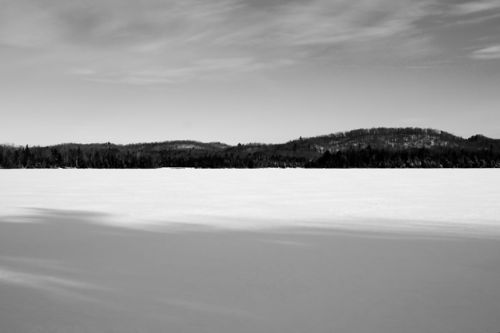
    Then again he went down to the frozen waters of Big Moose Lake to see if he could be seen. And when he determined that he could not see or be seen, he returned to the lean-to of branches he built against the uprooted base of a fallen pine tree. He knelt, in the shelter, and placed his hands on the mesh of smooth stone, tangled roots and dry dirt. He looked up, listening, and heard only a pair of aging hardwoods, aroused by the breeze, necking in the distance. It was a polka-dot Heaven through a thatch-work quilted evergreen ceiling. And he breathed deep, as if to pull the stars a millimeter closer. For the companionship of the reflection of a friend’s face that might be found in a faraway moon. For the warmth of a stranger’s hug that might reach for him on a meteoric thundershower of a little bit of love.

    Then he lay down on the earth, cleared of snow, his head resting on a pile of fir branches he had gathered many hours ago. His nostrils stung of pine and his ribs pressed hard through his flesh against the frozen ground below. There was little he could do now, but look up, keep his eyes open, and dream of being found.

    Forever, he thought of escaping, and now – here in this wilderness that was so brutally foreign – all he wanted was the familiar, generic, daily routine he had left behind. He started to softly sing:

    It’s a world of laughter, a world or tears
    It’s a world of hope, and a world of fears
    There’s so much that we share
    That it’s time we’re aware
    It’s a small world after all

    It’s a small world after all
    It’s a small world after all
    It’s a small world after all
    It’s a small, small world

    There is just one moon and one golden sun
    And a smile means friendship to everyone.
    Though the mountains divide
    And the oceans are wide
    It’s a small small world

    This is a 20 minute story, which means I wrote it in roughly 20 minutes. I’ve done this before, and you can read those entries here. This entry was originally written from 10:15 am to 10:45 am on Sunday, January 15, 2012 in the clubhouse at Stokely Creek Lodge in Canada. I revised it on January 17, 2012. It was inspired by nordic skiing in the Canadian wood, where there were many lakes and fallen-over pine trees. The lyrics to “It’s a Small World” were added at the last minute, probably from a subconscious need to lighten the tone of the vignette. At play here is a desire to escape the routine, yet the fear that if or when that is accomplished that there will be nothing there. That it will be for naught. And in realizing that, to recognize the fullness of the present.

  • The Daily: Untitled

    The few cured leaves pinch,
    With forefinger and thumb.
    Those little daredevils
    do tempt the wind to come.
    And as they float in place,
    The white sun does rise;
    They play it like a cinema
    for his looking eyes.